Kasetsart University successfully sent Thailand’s first payload — a liquid crystals (LC) experiment — into space.
9/15/20252 min read
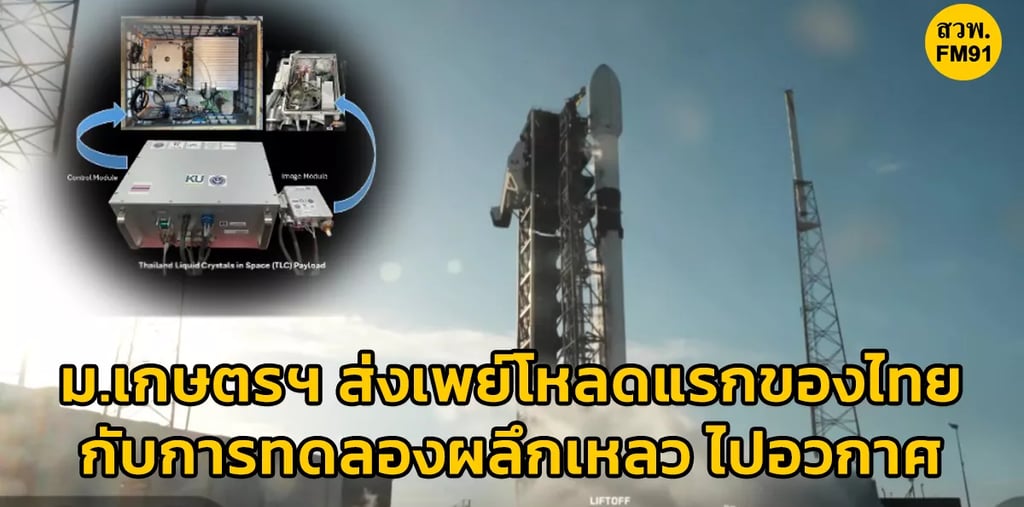
On September 15, 2025, at 5:02 a.m. (Thailand time), the payload from the Thailand Liquid Crystals in Space (TLC) project was successfully launched aboard the Cygnus spacecraft of Northrop Grumman on the NG-23 mission, which operates under NASA’s Commercial Resupply Service Mission (CRS) program.
The Cygnus spacecraft was launched into space by a Falcon 9 rocket from SpaceX, heading to the International Space Station (ISS). The experiment will be conducted in orbit for a duration of three months, totaling 144 experimental hours.
The liquid crystal experiment in space aims to develop next-generation Liquid Crystal Display (LCD) technology, surpassing what is currently used on Earth. LCDs, which are widely used in mobile phone screens, represent a major global industry valued at approximately 150 billion USD per year, and this figure is projected to grow to 1.4 trillion USD by 2029, making it one of the world’s most significant and pervasive technologies.
Associate Professor Dr. Nattaporn Chattaem explained that liquid crystals are fluids that respond to electrical currents, allowing control of light. When used in LCDs, applying electricity causes the molecules to shift, enabling light manipulation and brightness control—a principle that underlies most modern display screens.
This research, however, focuses on developing liquid crystals capable of withstanding harsh space environments, paving the way for use in communication displays on space stations, astronaut suit panels during extravehicular missions, and even future space tourism or orbital hotel applications.
The development of this space-grade payload underwent four rigorous safety reviews by NASA committees—Phase 0, Phase I, Phase II, and Phase III Safety Reviews—at NASA’s Johnson Space Center in Houston, Texas, USA. Only after passing all reviews was the payload approved for launch. The experiment and launch operations received over 500 million THB in funding support from the U.S. ISS National Laboratory and NASA.
The Thailand Liquid Crystals in Space (TLC) project originates from a Memorandum of Understanding (MOU) signed on June 24, 2021, between NASA, represented by Dr. Meredith M. McKay, Director of the Human Exploration and Operations Division, and Kasetsart University, represented by President Dr. Chongrak Wachrinrat.
This MOU enables researchers from Kasetsart University and the Geo-Informatics and Space Technology Development Agency (GISTDA), led by Assoc. Prof. Dr. Nattaporn Chattaem from the Department of Physics, Faculty of Science, Kasetsart University, to conduct studies on liquid crystals aboard the International Space Station (ISS).
Notably, this MOU marks the first collaboration between NASA and a Southeast Asian nation for a space experiment.