Astronauts begin microgravity liquid crystal research mission for Thailand’s TLC project.
12/19/20253 min read
Astronauts Begin Microgravity Liquid Crystal Research for Thailand’s TLC Project on the ISS
The long-awaited milestone has arrived. Thailand’s TLC payload (Thailand Liquid Crystals in Space)—a Thai-developed space research payload for liquid crystal experiments—was installed and activated for testing by NASA astronaut Mike Fincke on December 1, 2025, at 9:30 a.m. Texas time.
Fincke installed the TLC payload into the KERMIT microscope (KEyence Research Microscope Testbed) aboard the International Space Station (ISS) and replaced the microscope’s filter with the dedicated TLC project filter delivered with the payload.
120 Hours of Microgravity Experiments Led by Kasetsart University
This important mission is conducted in collaboration with the TLC research team led by Assoc. Prof. Dr. Nattaporn Chattam from the Department of Physics, Faculty of Science, Kasetsart University. The project studies thin liquid-crystal films in microgravity for a total of 120 hours of space-based experimentation, running from December 1 to December 22, 2025.
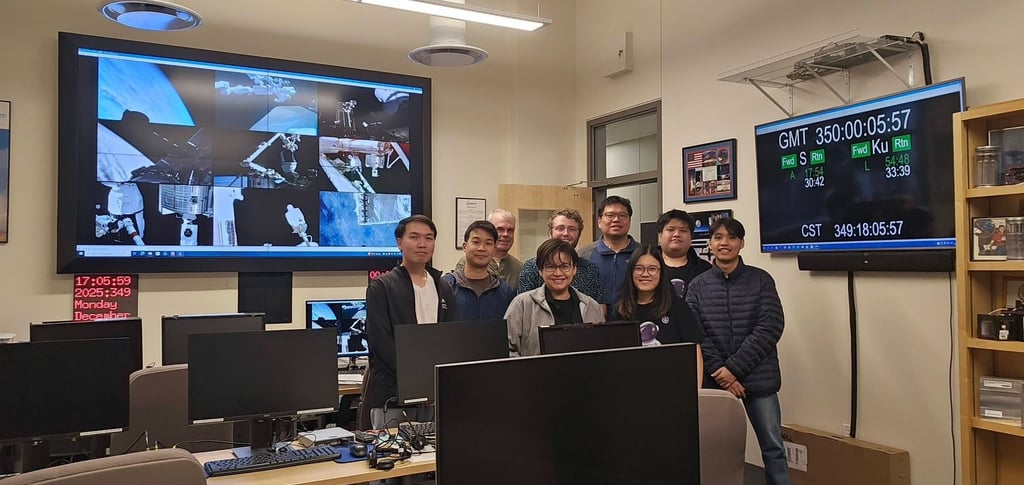
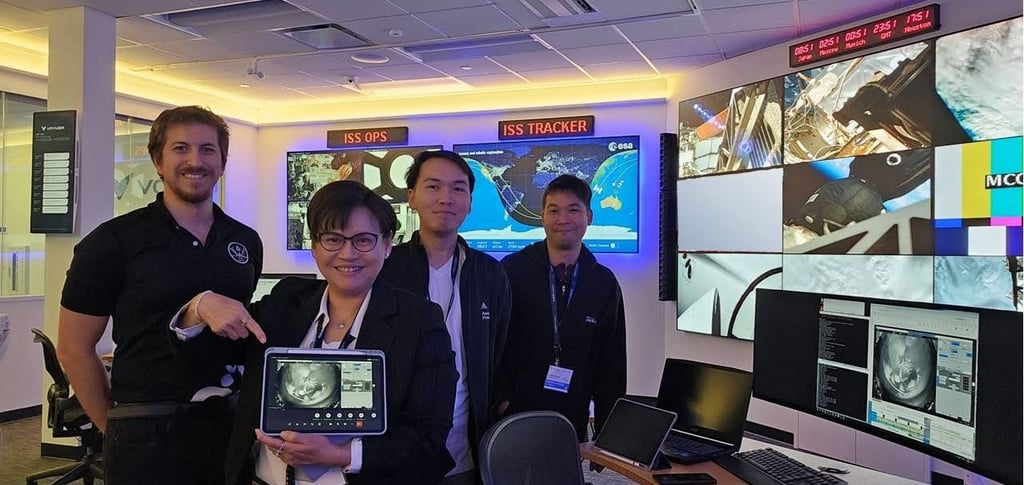
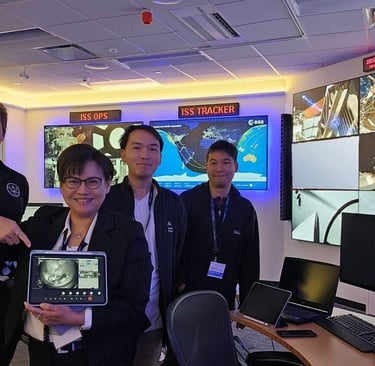
Each morning, astronauts are required to install the payload and initiate operations for the research team. The experiments are controlled remotely by the Thai research team from the payload control room at Voyager Technologies in Houston, Texas, while the KERMIT microscope is operated by the control team at BioServe Space Technologies in Boulder, Colorado.
During the mission, astronauts take turns changing KERMIT microscope filters to the TLC filters appropriate for each experiment configuration. A total of five astronauts are supporting the TLC experiment operations:
Commander Mike Fincke (NASA)
Zena Cardman (NASA)
Kimiya Yui (JAXA)
Chris Williams (NASA)
Jonny Kim (NASA)
Focus: Defects in Thin Liquid-Crystal Films
The TLC project aims to investigate defects in thin liquid-crystal films through three sub-experiments:
Thin liquid-crystal films under environments with vapor pressure differences
Thin liquid-crystal films under air shear
Thin liquid-crystal films under environments with temperature differences
Research Team
The project team includes:
Principal Investigator: Assoc. Prof. Dr. Nattaporn Chattam
Deputy Principal Investigator: Asst. Prof. Dr. Apichat Phatthanaphokhrattana
Wutthiphon Sathianphaisan, software engineer and master’s student
Chaturong Chanria, electrical engineer
Theerathat Chomchok, PhD student
Experiment 1 lead: Jutharat Kaewthong (researcher)
Experiment 2 lead: Noppadon Saniwong na Ayutthaya (master’s student)
Experiment 3 lead: (as stated by the project team)
Payload Development and NASA Safety Reviews
According to Assoc. Prof. Dr. Nattaporn Chattam, development of the TLC payload took about two years, with Voyager Technologies serving as the implementation partner. The mission was managed by Mr. Marcello Corporicci, supported by Voyager engineers to ensure the payload complied with NASA standards. The payload was required to pass four phases of NASA safety reviews before being certified for deployment to the ISS.
“Having the payload in space and being able to conduct different experiments is a tremendous source of pride for our team. We’re happy it is operating exactly as designed, and that it survived the intense vibrations of launch and is still functioning as planned. This demonstrates that Thai research meets international space standards. I want to tell Thai people that we can compete globally without fear. With full effort and determination, we can reach our goals—we can definitely reach space.”
Earlier Launch: Sent to the ISS via NASA CRS Mission
Earlier, on September 16, 2025, the TLC payload was successfully launched from Cape Canaveral, Florida, USA, at 05:11 a.m. Thailand time. The mission was part of NASA’s Commercial Resupply Services (CRS) program. TLC flew inside Northrop Grumman’s Cygnus spacecraft, flight NG-23, and was delivered to the ISS aboard a SpaceX Falcon 9 rocket.
Funding Support and Technology Impact
The Thailand Liquid Crystals in Space project received funding for payload construction and testing from Thailand’s PMU-B under TSRI. Funding for launch and on-orbit operations was supported by the U.S. ISS National Laboratory and NASA, totaling more than 500 million baht.
The purpose of conducting liquid-crystal research in microgravity is to enable next-generation LCD (Liquid Crystal Display) technology beyond today’s applications. LCDs are widely used in mobile phone screens across all segments of the population. By removing the effects of Earth’s gravity, microgravity experiments can significantly reduce defects in liquid crystals, potentially allowing the material to respond more effectively to electric fields than on Earth.