A major milestone for Thailand in space! Astronauts have begun a liquid crystal research mission aboard the International Space Station throughout December 2025.
12/18/20251 min read
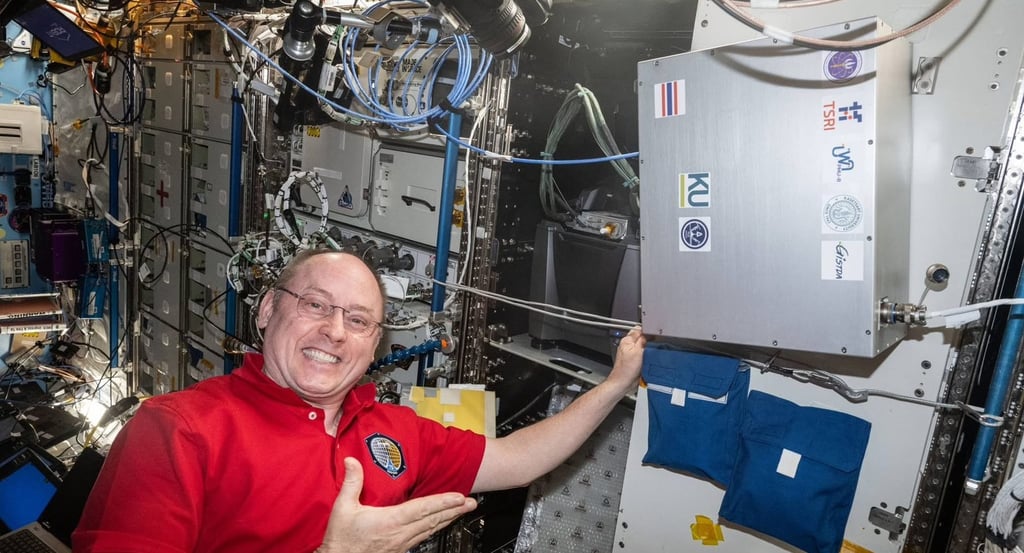
Thailand’s historic space collaboration is flourishing more than 400 kilometers above Earth, as the current crew aboard the International Space Station (ISS) has begun the full-scale installation and equipment changeover for the “Thailand Liquid Crystals in Space” project, or Thailand Liquid Crystals in Space (TLC). The mission aims to study crystal formation processes under low-gravity conditions, with potential benefits for future industries.
The mission began when Mike Fincke, an experienced astronaut from NASA, installed the TLC payload (the experiment hardware package) onto a high-performance research microscope called KERMIT—essentially the station’s sharp “eyes” for observing microscopic-scale objects. Mike also replaced the microscope’s filter with a special filter package sent up with the project, specifically tailored for measuring the properties of liquid crystals.
A highlight of this mission is the collaboration of five astronauts who are rotating responsibilities to closely supervise and operate the experiment. The team is led by Commander Mike Fincke, joined by NASA astronauts Zena Cardman, Chris Williams, and Jonny Kim, along with Kimiya Yui, an astronaut from the Japan Aerospace Exploration Agency (JAXA). Having multiple experts oversee the work underscores both the importance and the sensitivity of this Thai experiment package.
The experiment is scheduled to run from 1 December 2568 to 22 December 2568 (1–22 December 2025), totaling 120 hours of experimental time aboard the ISS. Data gathered from observing liquid crystal behavior without gravitational disturbances will help Thai scientists understand molecular alignment in ways not possible on Earth. This knowledge may lead to significant advances in display technologies or high-performance modern materials.
🖥️ The TLC project investigates liquid crystals under microgravity conditions on the ISS. The project received primary funding support for payload development and spaceflight testing from the Program Management Unit for Human Resources & Institutional Development, Research and Innovation (PMU-B). The project has also been coordinated through research collaboration among specialists from the Faculty of Science, Kasetsart University; the Geo-Informatics and Space Technology Development Agency (Public Organization) (GISTDA); NASA (USA); and the ISS U.S. National Laboratory.